
 Get emergency food
New parliamentary inquiry
How should the rate of universal credit be decided?
The amount Universal Credit payments are fixed at has never been set against any real costs. No independent evidence. Just a political decision – and nobody is properly or regularly checking it against the cost of essentials.
With Trussell's research finding that 75% of people turning to food banks are receiving Universal Credit payments, we know this isn’t right. Because currently, it’s not covering the cost of essentials we all need to get by, like food, bills and toiletries – and it’s pushing people to food banks as a result.
That’s why on 29th June, parliamentarians from across party lines came together on something they all agreed upon: that no one in the UK should be having to turn to a food bank to get by.
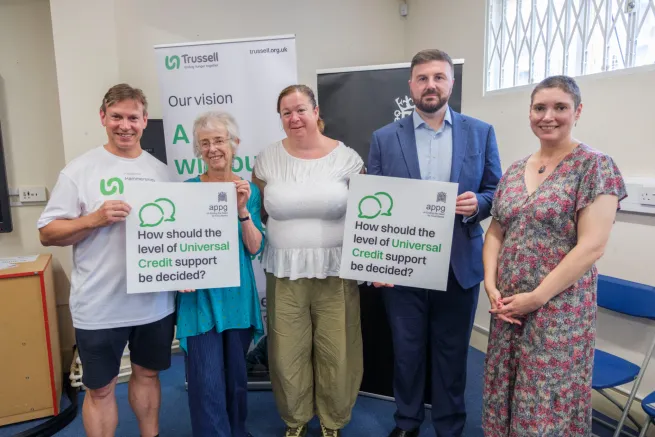
The All Party-Parliamentary Group (APPG) on Ending the Need for Food Banks new inquiry that asks a crucial question: How should the level of Universal Credit be decided? Because at the moment, it's not fit for purpose.
Hosted in Hammersmith & Fulham Foodbank, speeches were given by CEO Phil Storey, Trussell’s director of policy and research Helen Barnard, Zoe Boorman, who has experience of turning to a food bank to get by, as well as inquiry members Baroness Lister, Chris Webb MP and the Bishop of Manchester.
The inquiry runs until Monday 7 September and Trussell is encouraging everyone to share their evidence – people with experience of the system, charities, think tanks, trade unions and members of the public. By contributing to this inquiry, you can help build the case for change – towards a future where everyone has enough to live on, and where food banks are no longer needed.
Together, we have an opportunity to help shape a social security system that protects people from hardship, rather than pushing people towards it.
Baroness Ruth Lister, Chair of inquiry team: “We are facing a relentless false narrative about a so-called ‘ballooning welfare’ budget. So, it’s not the easiest time to launch this inquiry politically, but it makes it all the more important. I can tell you that Universal Credit is not fit for purpose, which is why we need this inquiry. This inquiry asks a crucial question: how do we set the basic safety net benefit? It’s great that the two-child limit has been lifted, but it doesn’t mean that Universal Credit is in any way adequate.”
Helen Barnard, Director of Policy and Research at Trussell, said: “Parliamentarians are coming together across party lines, because whatever else we disagree on, we can all agree that nobody should be left without the money for essentials. Just over half of people on Universal Credit don’t have enough money to afford food, and it’s been getting worse over the last few years. Costs have gone up while incomes haven’t kept up.
“When I speak to people about how the basic rate of Universal Credit is set, they are shocked that it isn’t informed by any evidence or independent advice about what the essentials cost. This inquiry is a chance to agree how to put Universal Credit on a firmer footing. I see it as a beacon of hope that we can solve this.”
Chris Webb MP for Blackpool South and inquiry team member, said: “Blackpool is the most deprived borough in the country. Towards the end of the month in my constituency, I see people in work who just can’t afford to make ends meet. A financial shock, such as their car breaking down, can push them into crisis and force them to turn to a food bank. Universal Credit is not measured against the cost of essentials and that is wrong. This inquiry is about making sure that no adult or child is going hungry, because it’s not right. Our welfare system should be fit for purpose, and at the moment it’s not.”
Zoe Boorman – food bank volunteer with lived experience of turning to a food bank: “I’m a full-time carer for my husband who’s terminally ill, and we have three children living at home. I'm receiving Universal Credit and have had to turn to a food bank because of the eight-week wait to receive my first payment.
“Every week, every month on Universal Credit is a struggle to make ends meet. It’s not based on how much things cost, and for families like mine, it barely covers the cost of our bills, let alone the cost of food.
“Many people don’t understand how little Universal Credit is to live on, or how difficult the system is to navigate. You never speak to the same person twice. Policy should be made by the people for the people. Seeing politicians from across the political spectrum coming together on this really important issue makes me feel that change is possible for families like mine.”
The Rt Rev Lord David Walker, Bishop of Manchester, inquiry team member, said: “There’s hardly a church in my diocese that doesn’t have a link to a food bank. But back when I joined my church in 2000, I hadn’t heard of them. The growth of food banks is a tremendous tribute to human endeavour and community’s ability to tackle social ills, but it’s a dreadful indictment on our nation that we have so many people that actually require the use of food banks.
"I think the only solution is Britain finding the same political will that it did in the 1940s and 1950s in the aftermath of the Second World War. We need to reimagine a modern inclusive welfare system that makes sure everyone who lives on this land can have access to affordable, nutritious food. I welcome this inquiry and the opportunity to be a part of it.”
Photo: Jess Hurd